Oliver and Barbara’s fatal house collapse
The War of the RosesOliver and Barbara’s fatal house collapse is the terminal disaster of the Roses’ domestic war: the hazards accumulated inside their home become a physical chain of falling objects and failing structure, and Oliver’s attempt to save Barbara ends with both of them beneath the wreckage. The children escape, but Ann’s discovery of their parents dead in an embrace gives the destruction a final, devastating intimacy.
Causes and Background
The collapse unfolds as the children return to a house already made perilous. Knocking and voices at the entrance give way to the sound of the door opening; Oliver rushes from a room, loses his footing among broken figures, and falls. Through the brass slats of the banister, he sees Eve and Josh enter. The floor is slick: they struggle upward, fall again, and grope toward the stairs. The danger is not a single obstacle but an interior in which ordinary routes and objects have become part of a sequence of hazards.
When the children press forward, the untacked stair carpet gives way beneath their hands. Cast-iron pots roll into an avalanche, the clock begins to chime in an abrasive rhythm, and pictures fall from the walls. Eve and Josh press together and narrowly avoid the pots. The house’s disorder makes the family’s conflict immediately physical: the children are trying to reach their parents, but the familiar staircase and its contents impede them. Barbara’s desperate calls for them to go back are not enough to stop their advance.
The Rescue Attempt
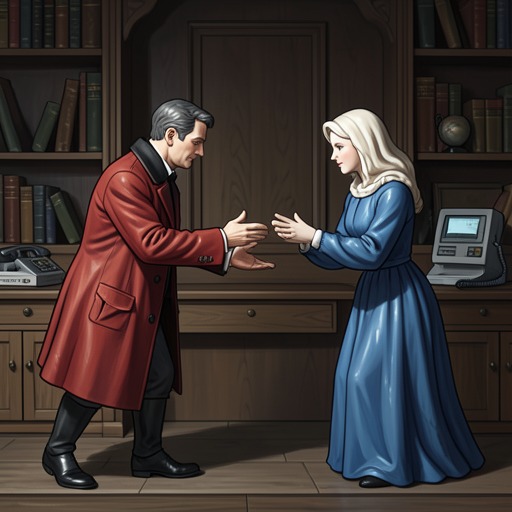
Seeing Barbara on the landing, frightened and looking down at him, Oliver hears her ask him to save their children. The appeal changes his attention from the struggle between them to their shared responsibility for Eve and Josh. For a moment, he sees what he remembers as Barbara’s former softness and senses the significance of their first meeting at Chatham. The possibility that something remains between them flickers in the middle of the emergency; the scene does not establish a reconciliation, but it makes their last actions more than a contest for control.
As the children move again, more objects fall. Barbara steps too close to the banister, which has fallen into the chandelier well below, and loses her balance over the unprotected ledge. She hangs two stories above the floor. Oliver tells Eve and Josh to get out and promises to save Barbara. They slip through the debris and reach the open doorway, where they watch from outside.
Oliver attempts a dangerous rescue using the chandelier. From the balcony’s edge, he judges the distance, jumps for its heavy chain, and climbs along the metal rungs. He swings the chandelier in a wide arc toward Barbara’s ledge, making several passes that fall short before he finally reaches it and grips the edge. Barbara’s hold is failing. Oliver urges her to take his forearm, but she refuses; when he has to pry her fingers loose, she reflexively reaches out with her other hand and embraces him as her weight transfers to the chandelier.
Collapse and Deaths
The chandelier creaks and bounces under their combined weight. Oliver has barely time to look up before it slips beneath him. He falls with Barbara as the ceiling opens above them; the account breaks off with his thought of whether he will soon see the sky. The rescue has brought them together, but it cannot secure either of them. Their shared fall converts a desperate attempt to prevent one death into the beginning of the final catastrophe.
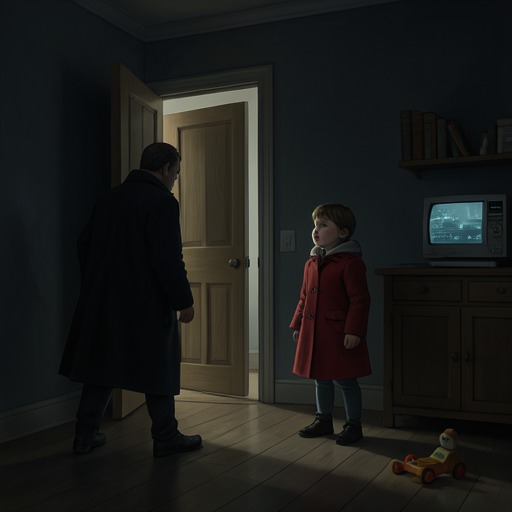
Outside, Ann hears the crash just as her cab pulls away and stands motionless while dust streams from the open entrance. She sees Eve and Josh in the cloud, their faces and hair covered in dust, their eyes glazed with terror. When they turn back toward the house, Josh says that their parents are inside. Ann blocks their path and holds them as falling objects continue to clatter within. Once the noise subsides, she leads them toward the entrance, though they follow her into the wreckage.
The damage is visible at the threshold: the roof has collapsed, the interior walls have buckled, and the long clock lies on its side with its Roman-numbered face smashed. Shards from the chandelier cover the surfaces, and fresh clouds of dust rise as Ann searches. She finds Oliver and Barbara beneath the rubble, coated in white dust, their faces fixed in death. They appear to be embracing, their lifeless eyes locked together. The image confirms both deaths and gives the rescue attempt its final, ambiguous form: the embrace that began as Barbara’s reflexive grip is now the last visible relation between them.
Survivors and Significance
Eve and Josh survive the collapse and reach the exterior, but their first impulse after the crash is to go back for their parents. Ann restrains them, then enters with them; their grief accompanies the search rather than ending at the doorway. The children’s question about why their parents did this expresses the bewilderment left by the destruction, while Ann can only shake her head. The house that had contained the family has become debris around the deaths it could not prevent.
The event reverses the meaning of the house as a place of possession and protection. Its banister, stairs, carpet, pots, clock, and chandelier become immediate dangers, and the accumulated disorder culminates in structural failure. The final movement is starkly divided: Eve and Josh escape, Ann returns to them, and Oliver and Barbara remain together beneath the wreckage. Their deaths close the conflict not with a settlement over the home, but with the home’s collapse and an image of the couple held in an embrace that neither can undo.